As I write this there are fewer that 20 places left. If you’re quick enough you can register now here.
We’ve got a great line-up of presentations:
Will Barlow, “The Throne Room Problem: Responding to Trinitarian Claims about John 12:41”
Kegan Chandler, “Cult-Rhetoric and Unitarian Christology: The Evangelical Creation of a Christological Other”
Sean Finnegan, “Isaiah 9:6 Explained: A Theophoric Approach”
Susanne Lakin, “Biblical Anthropomorphism: Evidence of a Unipersonal God”
Bill Schlegel, “A Non-Genesis Creation Interpretation of John 1:3-4”
Dustin Smith, “New Testament Portrayals of Wisdom Christology: Meaning, Function, and Purpose”
Dale Tuggy, “Mainstream Christian Theologies in the year 240 and Early Trinitarian ‘Fool’s Gold’ “
These presentations will be filmed and posted on the UCA’s YouTube channel. By the way we’re currently posting the presentations from our amazing UK International Conference in Windsor, England from July.
If the practical workshops are more your thing (and these are not recorded) stay tuned: I’ll post again soon with our exciting workshop line-up.
The UCA is delighted to announce our first ever international conference in New Zealand. Thanks to the efforts of Zach Mayo and his New Zealand conference committee, this has been organized for November 22 – 24, 2024 at the Don Rowlands Centre in Cambridge, New Zealand.
You can register here. Thanks to the generosity of the local hosts, registration is free!
The program is still be developed, and there will be a call for presentations; watch this blog. So far the following have been confirmed as presenters:
trinities podcast host, UCA Board member, and co-author of the forthcoming One God, Three Persons, Four Views, Dr. Dale Tuggy
To learn more about this conference and its organizer Zach Mayo check out this interview for the Restitutio podcast. He is what I call a “whistleblower,” an evangelical Christian who believes that doctrine should be based on Scripture even if it conflicts with later catholic traditions. Like so many, Zach and his wife carefully re-examined the Bible and found that there the one God is the Father only, and that Jesus is his unique human Son and Messiah. Now they have joined our worldwide reforming movement.
We’re hoping to meet unitarian Christians from all over New Zealand, Australia, the rest of Oceania, southeast Asia, and beyond. It will be a place to fellowship, learn, be encouraged, and make new connections with like-minded believers. You can register now here.
The Board of the Unitarian Christian Alliance is pleased to announce a general call for papers to be presented at the fourth annual UCA conference in Little Rock, Arkansas October 17-20, 2024.
The submission deadline is the end of the day (U.S. Eastern Standard / New York time) of August 1, 2024.
Please do not submit multiple papers.
Submissions will be blind-reviewed by a committee of three.
We are looking for scholarly (or at least: informed, insightful, and well-argued) papers which are also accessible to an educated lay audience on topics which can advance the cause of unitarian Christianity.
Topics may include but are not limited to: biblical theology, systematic theology, biblical studies, textual criticism, history of theology, history of unitarian Christianity, apologetics, Christian philosophy, analytic theology.
The committee will favor papers focusing on claims common to UCA members, rather than on “in house” disagreements.
Authors may submit even if they are neither a member of the UCA nor a unitarian Christian.
Paper submissions must conform to the Chicago Manual of Style (Notes and Bibliography style, with footnotes and bibliography).
The main text should be no longer than 6,000 words, so that the presentation is no longer than 45 minutes.
Submitted papers longer than 6,000 (in the main text – so not including footnotes) will be automatically rejected.
Authors should plan on about 10 minutes of audience Q&A after their talk.
Papers may be read, although authors are encouraged to present the material in an engaging way.
Conference presentations will be video-recorded and may be posted on the UCA YouTube channel, and our social media committee may also snip out interesting “sound bites” for short videos. By submitting a paper, you agree that your presentation may be filmed and used in these ways by the UCA.
Still, a fully written paper must be submitted; an outline or proposal is not enough.
Authors of accepted papers must supply a PowerPoint or Keynote or Google Slides (etc.) presentation to accompany their talk by the end of Friday, September 1, 2024. (This should be emailed to the address below.)
After removing any self-identifying features (e.g. your name, references to your other publications or other work), please email your submission to conference@unitarianchristianalliance.org.
Our conference coordinator will ensure that the papers are suitable for blind review and then pass them on to the committee.
The committee’s decisions will be emailed to authors by the end of Thursday, August 15, 2024.
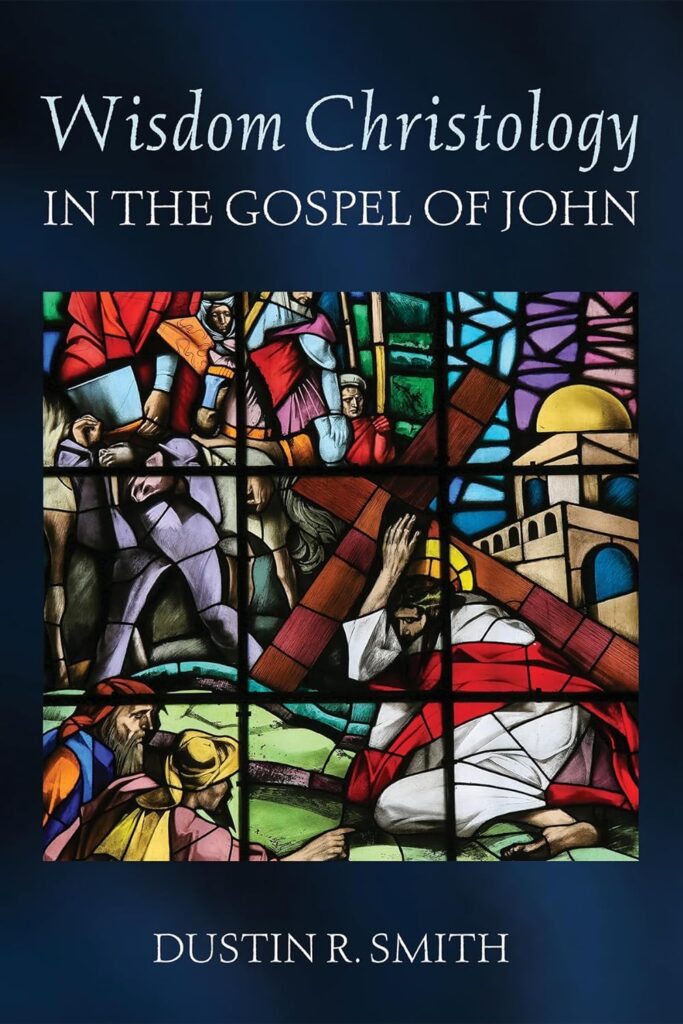
UCA member (and frequent presenter) Dr. Dustin Smith has just publishedWisdom Christology in the Gospel of John with Wipf & Stock. This scholarly monograph surveys and makes accessible an impressive array of recent biblical scholarship on the theme of wisdom Christology, in his words,
where the biblical authors apply various attributes, traits, characteristics, and roles that were originally associated with the personified wisdom of Israel’s God to the figure of Jesus Christ.
(p. 1)
This character Lady Wisdom will be familiar to all readers of Proverbs 1-9. But as Smith shows, this is just the tip of the iceberg as far as personifying wisdom. In his second chapter Dr. Smith surveys, as it were, the “pilgrimage” of this character through ancient Jewish literature, including biblical, deuterocanonical, and other books. Many of these books would have been familiar to the authors of the New Testament and their audiences. Thus, they may be relevant to understanding what those New Testament books really meant. Despite the creative imaginations of trinitarian interpreters, it is what comes before a writing, not what comes long after it, which helps to orient us into the author’s mindset.
His first chapter nicely introduces the idea of Wisdom Christology and surveys how this can be found in the New Testament in the letters of Paul, the letter to the Hebrews, and the first three gospels.
In his third chapter Smith argues, I think convincingly, that the Logos (Word) of John 1:1-18 is to be understood as a personification of God’s Word/Wisdom rather than a literal person. (More on that in this interview.) Dr. Smith provides us with a list of 20 (!) parallels between the language of John’s prologue and earlier wisdom literature (77-79).
The rest of the book (chapters 4-9) argues that the rest of this gospel continues this theme of Jesus as the embodiment of God’s wisdom. Many UCA members will be particularly interested in the treatment of texts in John which are often taken to imply Jesus’ pre-human existence (82-85, 217-18) or his descent from and ascent to heaven (105-7).
I was not as convinced by this portion of the book; he is arguing for causal influence from earlier wisdom literature to the fourth gospel (214-15), but it’s not clear to me that all the similarities support that thesis, e.g. “the hiddenness of Jesus as he escapes his enemies” (174) and “the inaccessibility of the wisdom of God” in Job 28:12-28. But Dr. Smith is taking a maximalist approach, gathering together all the alleged influences in John from wisdom literature that have been urged by recent interpreters. These will of course vary in plausibility, and one can accept the general thesis while rejecting some of the alleged examples of influence.
In sum, Dr. Smith succeeds at his goals of making a lot of recent biblical scholarship accessible to the non-scholar, and showing that earlier wisdom literature is an important interpretive key to understanding the original meaning of the Gospel According to John.
To hear Dr. Smith discussing these ideas check out his presentations below on Wisdom incarnate in Jewish sources at the 2023 UCA Conference and his 2024 conversation about this book on Sam Tideman’s Transfigured podcast.
On behalf of the UCA Board and the UK International Conference committee, I’m delighted to announce the opening of registration for two 2024 UCA conferences:
Each conference will feature that special UCA conference blend of thought-provoking presentations, practical workshops, and plenty of time for fellowship, food, and getting to know this year’s Conference Partners. Mutual encouragement is the order of the day, and interesting cross-pollinations and collaborations have resulted from past conferences. We are united by our convictions that the God of the Bible is the Father and that Jesus is his human Messiah. Come and make new connections with like-minded believers. You can register now at the above links; don’t delay, as space is limited.
The programs for each conference are still being built:
There will be a future post here about volunteering opportunites at the US conference.
We will shortly be emailing past Conference Partners, inviting them to be a part of one or both of these events. For the UK International Conference, see the terms here. For the US Conference see here.
The UCA is delighted to again have the Williamsburg Christadelphian Foundation as a Conference Partner. They state that their mission is to help “individuals and families grow their faith in God and His Son. . . We help nurture trust in God and Jesus that endures through all the ups and downs of life. WCF sponsors programs and special initiatives around the world that:
Root faith in the word of God, learning from the faith lessons of faithful people in the Bible
Nurture faith by supplying tools that spur a whole faith to develop – one of head, heart and hands.
Inspire stronger growth by connecting people of faith, fostering a spirit that edifies all.
Show faith to others by enabling generous service for Christ.”
Be sure to stop by the WCF table at the conference to find out more about how this amazing organization is serving as salt and light in this broken world.
The UCA is delighted to again have Spirit & Truth as a Conference Partner.
Spirit & Truth providesVirtual Fellowships on Zoom multiple days each week. If you’re not part of a local congregation, consider attending one of their online fellowships, where you will meet fellow believers who want to pray, hear the Bible taught, and follow Christ together.
One of their best resources is the Revised English Version (REV) Bible, a whole Bible translation that has been an ongoing project for over 20 years now. In addition to the translations, this project has produced an incredible amount of insightful commentary that particularly addresses difficult passages and traditionally misunderstood ones. The REV translation promotes important theological truths, such as belief in the Father as the one God, Jesus as God’s human Son and Messiah, the sleep of the dead, and the kingdom of God. Both the REV translation and the associated commentary can be viewed online or in the app. Check it out and try using the REV alongside other versions to further support your Bible study and enjoyment of the Scriptures.
I first encountered Spirit & Truth via their content-rich, long-running website biblicalunitarian.com. I returned to this site often as I wrestled with disentangling my understanding of Scripture from the distortions of later church traditions. They popularized the helpful term “biblical unitarian” to convey the understanding that God is the Father alone, and that his unique Son Jesus is a man who did not literally pre-exist as a spirit or a “divine Person” before being miraculous conceived and born.
They have recently launched Spirit & Truth Kids, whose goal is to provide children’s books, curricula for parents to teach the Bible to their kids, and Christian resources for children, including coloring books, recommended TV shows, and much more. The first volumes of two different book series have been released, with a third series to be released in early 2024. Each series will see new volumes regularly released over the next couple of years. The two available now are Faith Lessons for Little Ones: Volume 1 and Oliver’s Tales: Seeking Wisdom. Click on a link to check them out. If you know anyone who has kids and would enjoy reading a children’s book from a trusted source where they won’t have to avoid certain sections or re-word sentences that contain errors from church tradition, send them the link and let them know about the Spirit & Truth Kids initiative.
Be sure to stop by the Spirit & Truth table to get to know them and to find out more about what they’re doing.
We are thrilled to again have Compass Christian Church from Louisville, Kentucky, as a UCA Conference Partner. You may remember Pastor Will Barlow from his interview with Mark Cain on the UCA podcast (50. Church Plant) where he described how God had directed the formation of this new church. He described the process of faithful planning which took many months, coming to fruition in the Fall of 2022.
To connect with their group of husbands, wives, mothers, fathers, engineers, a nurse, soccer coaches, writers, programmers, Bible nerds (just to list a few), follow them on Facebook where they stream their services. And if you’re in the Louisville area, be sure to check out the Sunday morning service or another event at this dynamic, young church. I have been to a few services there, and I love Will’s preaching, the genuine worship, the welcoming believers, and the whole vision of the church.
We are overjoyed to have a local body of believers represented this year as a Conference Partner. May we return the blessing to them through our prayers and support. Be sure to stop by the table at the conference to meet them and find out how this church plant is going.
As I write this more than 150 people are registered for the third annual Unitarian Christian conference! We must give our “final” headcount to the awesome local caterers by the end of afternoon of Thursday, October 5, 2023—so please, if at all possible, register for the conference before then.
We will still accept some registrations after that, but at some point the food will run short and you may have to pledge to be last in the food line. (And trust me, you don’t want to do that!)
I’m looking forward to seeing new and old friends in Springfield, Ohio, October 19-21! To learn more about the conference and to register, go here.
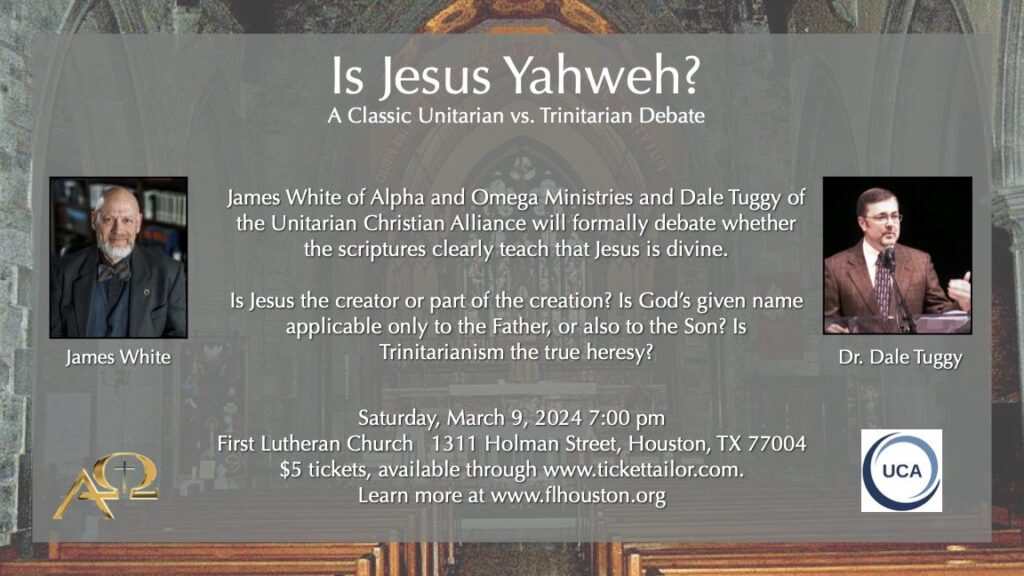
Back in 2017 I challenged Dr. James White to a debate. Now, God willing, it will happen, thanks to the efforts of host church Pastor Evan McClanahan. I am delighted to say that Unitarian Christian Alliance is co-sponsoring this debate. For those who can’t attend or catch the church’s livestream, you will eventually be able to see it on our excellent YouTube channel. Our topic will not be the Trinity, but rather the deity of Christ, in the form of the debate question Dr. White has chosen: “Is Jesus Yahweh?”
I’ve been in a similar debate before (video, soon-to-be-reprinted book). In that debate I argued that a unitarian Christology is easily stated in the very words of Scripture, whereas any “two natures” theory depends on questionable inferences from what is actually written. I urged that my opponent Mr. Date was “reading between the lines,” whereas I was just reading the lines. I began by pointing out the obvious numerical distinctness of Jesus and God, summarized the clear New Testament teachings that Jesus is a very special man who is someone other than the one true God (a.k.a. the Father), and then explained the desperate morass which is traditional catholic “two natures” speculations.
My approach will be different here. Dr. White has since his 1998 book endlessly hurled the accusation that every advocate for unitarian Christianity is “merely assuming” unitarianism and/or “merely assuming” that the human Jesus isn’t also divine. So I will argue in a style that undeniably does not assume such things. I will argue from more than a dozen facts about the New Testament, or rather classes of facts, each of which confirms the hypothesis that the authors believed that Jesus is a man who is not also divine over the hypothesis that they believed Jesus to be a “godman” (i.e. both human and divine). Dr. White has over the years urged that clearly it is “Philosophy” and not the New Testament which determines my views about God and Christ. But I will present a case for a non-divine, human Jesus which does not assume any controversial philosophical theses and which is based on a broad view of the whole New Testament, focusing on the many clear passages, and I will expose the many unjustifiable assumptions of Dr. White’s arguments for “the deity of Christ,” or as he prefers to say, that Jesus “is Yahweh.”
Tickets are available here; get them while they last!
We use cookies to ensure that we give you the best experience on our website. By clicking "Accept" on this banner, or using our site, you consent to the use of cookies unless you have disabled them.